
Americans hate gerrymandering — except when they don’t

The Supreme Court’s 6-3 decision this week in Louisiana v. Callais creates newfound uncertainty about what the congressional district maps will look like in 2026 and especially 2028. But one thing seems quite certain: we’re about to see even more fighting about maps.
The outcome of those fights is likely to be even more extreme partisan gerrymanders. Indeed, it is possible, thanks to the Callais decision, to justify maps that reduce or eliminate majority-minority districts on the basis of partisan goals.
And so, Tennessee Republican Senator and gubernatorial candidate Marsha Blackburn suggested a map that eliminates the state’s last remaining Democratic-held seat in the 9th District, which includes Memphis and is majority Black:
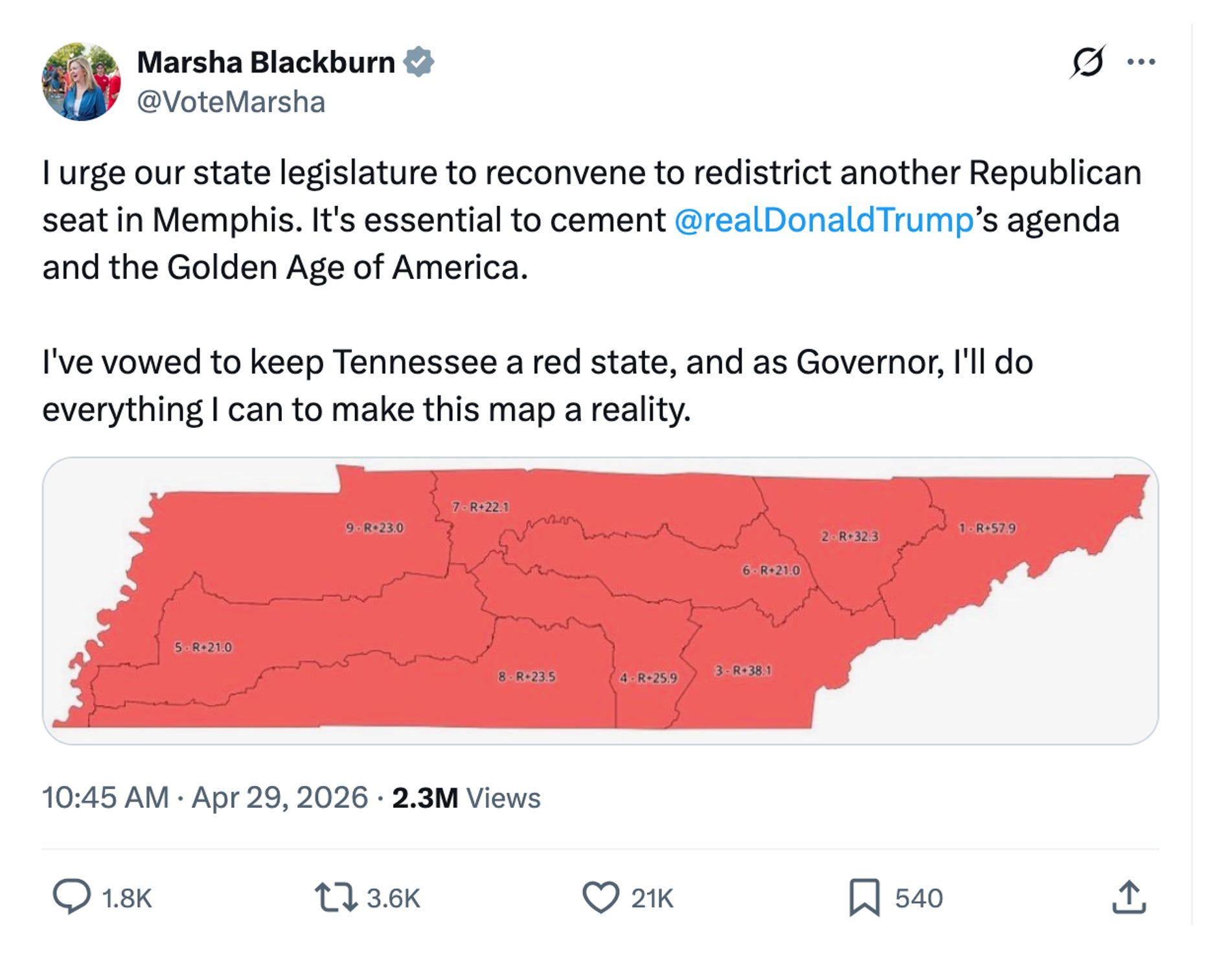
Under pressure from Donald Trump, Tennessee Republicans are indeed considering enacting such a map before the November election.
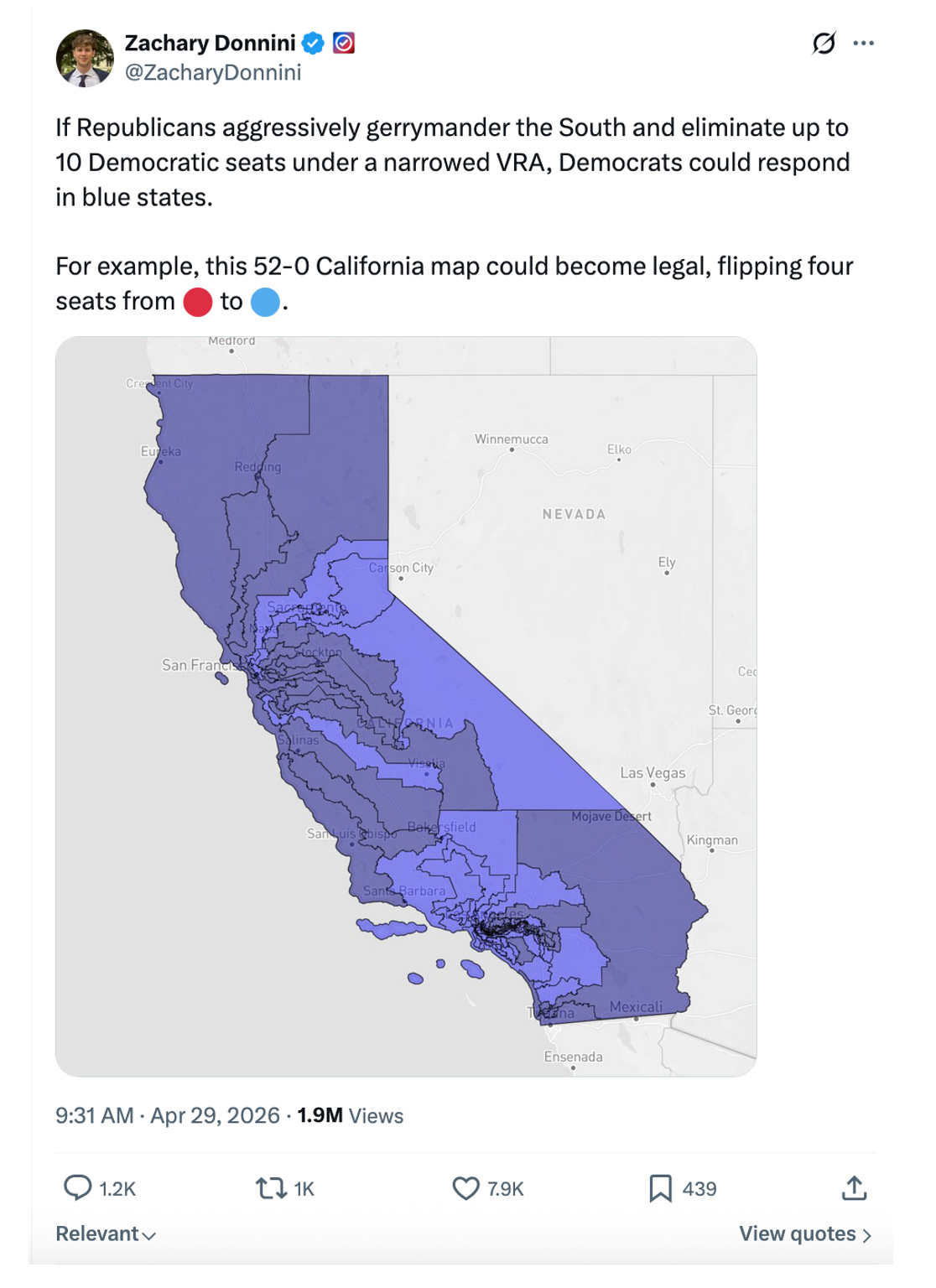
Meanwhile, Rep. Terri Sewell, an Alabama Democrat whose own district may soon be redrawn, said, “I’d take 52 seats from California and 17 seats from Illinois.” A map of a completely Democratic set of California districts has made the rounds:
There is not going to be any easy way out of this, I’m afraid. One reason? The public’s ostensible distaste for gerrymandering isn’t a reliable obstacle to partisan maps.
A rare bipartisan consensus: partisan gerrymandering is bad
This week, YouGov released a poll in which large majorities of Democrats and Republicans said that states should not “draw congressional districts in a way that intentionally favors one party over the other.”
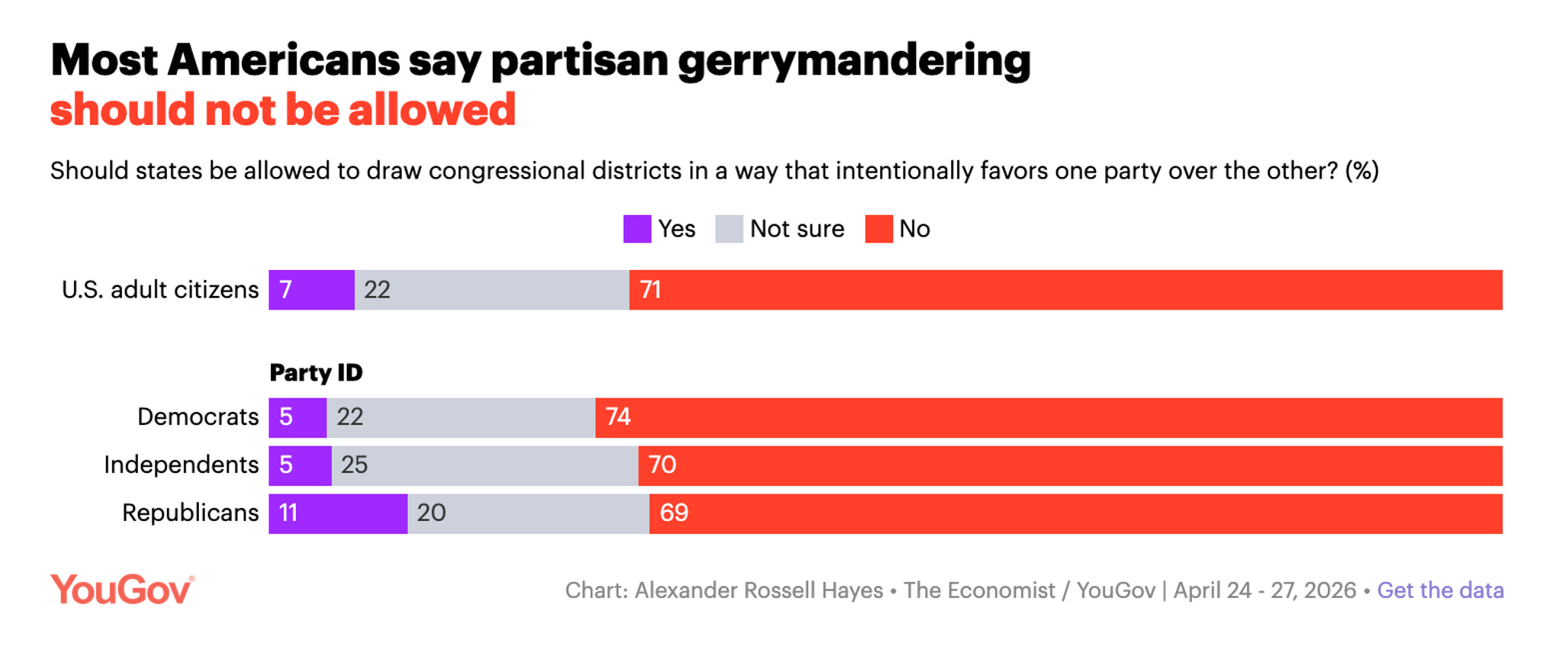
But it’s also apparent that many Americans aren’t knowledgeable about their own districts. When asked whether the districts in their state were drawn fairly or unfairly, 44% of people did not know. Of the rest, 24% said fairly and 32% said unfairly. In other words, only a third of Americans appear bothered by their legislative districts.
This is not a new finding. In 2022, the Pew Research Center also found a lot of ignorance about redistricting. For example, even in states where Republicans had drawn the map, only 38% of Democrats were dissatisfied, while 12% were satisfied and 49% didn’t have an opinion. The same was true among Republicans in states where Democrats had drawn the map, except even more of them (57%) had no opinion.
Part of the problem is that most Americans don’t know who actually draws their districts. Drawing on a different 2022 survey conducted after the 2021 redistricting, the political scientist Peter McLaughlin and co-authors found that only 36% knew who was in charge of redistricting in their state—the legislature, a redistricting commission, etc.
And knowledge was consequential: Among people who actually knew who drew the district maps, there was much more satisfaction with redistricting in states that used truly independent commissions than in states that used legislatures.
Americans weigh both ends and means
When Americans are asked to evaluate district maps, it’s not just about how maps are drawn (the means) but who ultimately wins (the ends). In the McLaughlin et al. study, for example, satisfaction with redistricting was lower if you were represented by an opposite-party politician in the U.S. House.
Moreover, the people most satisfied with redistricting were actually those whose map was drawn by a copartisan majority in the state legislature, not those whose maps were drawn by an independent commission. As McLaughlin and colleagues write, “people are more concerned with partisan power dynamics than procedural fairness when it comes to their home state’s redistricting process.”
Would partisan ends always take precedence over procedural fairness? Maybe yes, maybe not. Some other research by Devin McCarthy finds that majorities of people prefer fair maps to gerrymandered maps that would favor their party.
Regardless, the evidence suggests that public opposition to gerrymandering can be soft. If citizens are focused on ends, not means, then they may be tempted to play hardball, as California voters did this year by allowing the state legislature, not the state’s independent commission, to draw district maps for 2026-30 and thereby help nullify Republican attempts to gain seats by drawing new maps in Texas and other states.
Let’s just do proportional representation, then?
The prospect of endless gerrymandering wars has led many to advocate for a new electoral system: proportional representation. Maybe that is the right solution. But it’s a hard sell, too. Voters who are sick of gerrymandering may not realize that proportional representation is a solution. Even if they did, they might not support it.
For example, in the December 2018 VOTER Survey, respondents were given two options:
“People elect representatives by voting for individuals rather than parties. Each party gets the number of seats in the legislature that its individual candidates win, regardless of the percentage of votes cast for that party’s candidates overall.”
“People elect representatives by voting for a party rather than for a single individual. Each party receives a percentage of seats in the legislature that is roughly equal to the percentage over the vote that this party received.”
The first is the system we have. The second is a version of proportional representation. What did people prefer? The system we have. Just over half (52%) chose that. Most of the rest (31%) weren’t sure and didn’t choose. Only 17% chose proportional representation.
A 2022 survey generated the same finding: Many people didn’t have an opinion about proportional representation and, among those who did, opponents outnumbered supporters 2-to-1.
Do those polls mean that proportional representation will always be unpopular? I don’t think so. Most Americans lack strong opinions about electoral reform, period. Their minds could change.
Or they might not. The problem confronting reformers is this: Opposition to partisan gerrymandering doesn’t necessarily lead to support for reforms that would actually get rid of gerrymanders.
 | A guest post by
|