
Good to Know: How composition effects can distort election narratives
Can elections reveal the public’s true opinions? It depends on who shows up to vote.

After each election cycle, politicians, pundits, and election experts try to explain what the final results can tell us about the public’s mood. Often, these post-election narratives use terms like “shift” and “swing” to describe a public that has changed its mind about party support or its political identity. Compared to public polls and social media, election results feel like the truest reflection of public opinion – and so we eagerly await what they can tell us.
When comparing election outcomes across different years, it’s easy to forget that each election brings different people out to vote. Even across presidential election years, where turnout is relatively stable, each cycle creates a unique group of voters who actually show up to vote.
Political scientists call shifts in group outcomes due to a different mix of group members “composition effects.” It’s an important concept for understanding elections. Even a relatively moderate change in who shows up vs. who stays home can have large effects on the outcome of a specific election. And it’s important to understand that the post-election narratives will also change.
Here’s an example. Following the November 2025 elections in New Jersey and Virginia, headlines proclaimed that the public, including voting blocs like Latinos, Black men, and young voters, had swung wildly away from President Trump’s policies, only a year after moving away from the Democratic Party in the 2024 presidential election. We know from polling that some voters change their minds, but rapid swings of this size do not really fit with how we understand individual political identity and behavior.
So are American voters really this indecisive or is something else going on?
Off-cycle elections are particularly tricky
Composition effects are especially important to keep in mind when comparing elections of very different sizes, as was the case in New Jersey and Virginia in 2024 and 2025. Significantly fewer voters typically turn out to vote when it is not a presidential election year. That’s to be expected in the 2026 midterm elections, as it was in these two 2025 off-year elections. The lower turnout also changes who “the public” is. The composition of these different voting publics obscures what we think about their political demands.
The New Jersey governor’s election in 2025 offers a useful example of the pitfalls that composition effects can create. Unlike in Virginia, New Jersey polls showed a competitive race, with both parties fielding well-qualified candidates. New Jersey Republicans held onto a small but real hope that they could pull off an upset.
New Jersey was also a good test of narratives about recent voter shifts towards Trump and the GOP. A heavily Democratic state, with traditionally entrenched machine politics, New Jersey nonetheless swung drastically to the right in 2024. Some pundits began to wonder if the reliably-blue state might be up for grabs in the near future.
Expectations and reality
The 2025 New Jersey election was a huge national narrative moment – and a test of the support for Donald Trump’s policies. And then the results came in. Democrat Mikie Sherrill beat Republican Jack Ciattarelli by more than 14 percentage points. This margin was substantially larger than the presidential vote margin in the state just one year prior (6%) and even swamped the 3% margin from the last time the Democrats won the governorship in 2021. It was a political wipeout across the state.
The revised narrative coming out of New Jersey was that voters had suddenly flipped back to the Democratic Party. The results clearly showed that some sub-groups like Latinos, who had swung right in 2024, had swung back left a year later. These narratives sometimes downplayed the role of composition effects to explain the results.
The consequences of (not) showing up
Turnout in 2025 was historically high in New Jersey. In fact, 55% of registered voters showed up to cast their ballots, compared to 40% in recent gubernatorial and midterm elections. Nonetheless, voter turnout last November was substantially below the 65% turnout for the 2024 presidential election. That means 1 million New Jersey citizens who voted in 2024 stayed home in 2025. This would not be a composition effects problem if the partisan makeup of the voters stayed the same. By all accounts it did not.
Democrats turned out at high rates, and to some extent so did Republicans, but voters who registered as “unaffiliated” did not. And there are a lot of unaffiliated voters in New Jersey. In fact, they make up about 35% of New Jersey’s voter pool. This factor appears to be why the New York Times found less of a role for composition effects in the week following the November 2025 election.
Staying home is a kind of vote
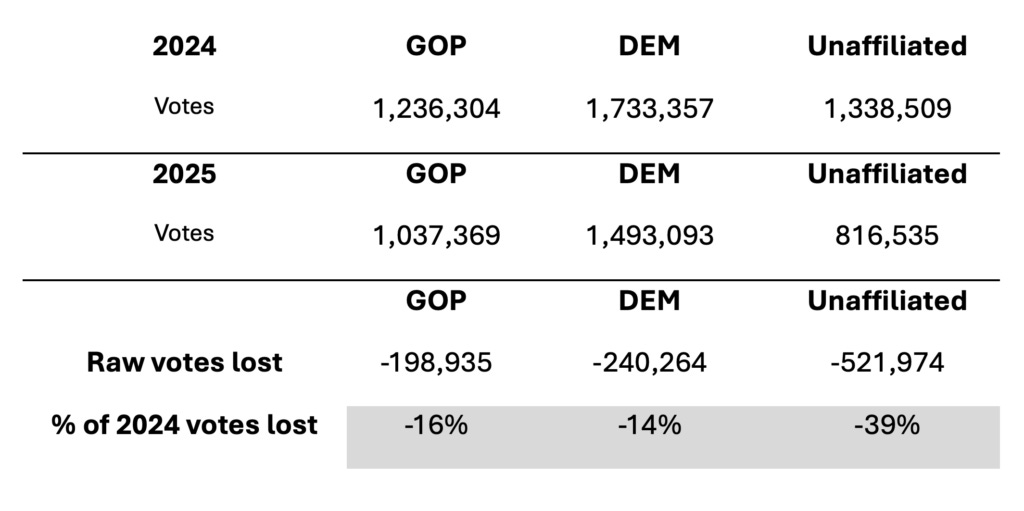
Some turnout data can help illustrate the difference between composition vs. conversion effects – when voters switch party votes. The data I use come from Decision Desk HQ and the New Jersey Division of Elections. Party ballot data provide some evidence of what happened in New Jersey in 2025. The numbers in the figures below count all returned party ballots in New Jersey’s 21 counties.
The data confirm that all groups saw a drop-off in turnout when comparing the 2024 presidential election to the 2025 election. One way to look for possible composition effects is to see if the parties lost voters evenly. Based on these data, that was not the case. Republicans lost a greater percentage of their 2024 voters (16%) than Democrats did (14%), and the number of unaffiliated voters declined by nearly 40% (see Fig. 1).
If we look instead at simple overall turnout across these groups, which accounts for changing party registrationbetween 2024 and 2025, we see the same pattern. Democrats had less of a drop-off than unaffiliated and Republican voters (see Fig.2).
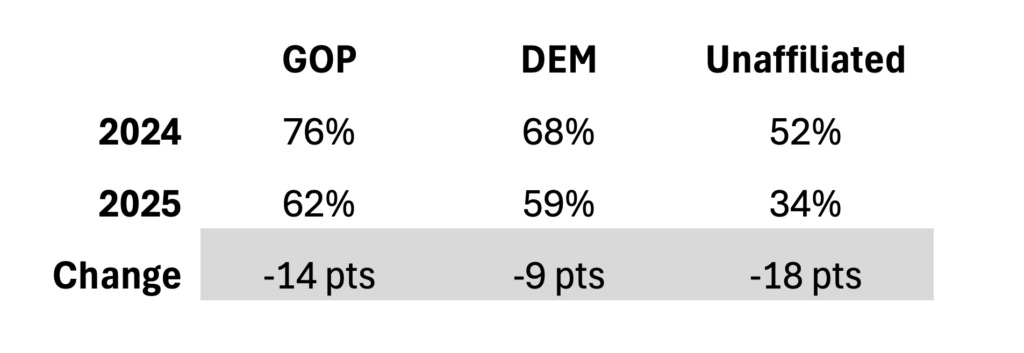
This uneven party turnout is enough to explain the big shifts from 2024 to 2025 in New Jersey. This does not mean that it does fully explain the shifts we saw since 2024. In fact, we know from exit polls and focus groups that some voters changed their minds since the 2024 election. But those same polls show that the overwhelming majority of voters did not change their minds, and certainly not enough of them to explain these massive swings from one year to the next.
If the voters who stayed home in 2025 were more likely to be 2024 Trump voters, then there was a different electorate and the outcome depended less on people shifting their loyalties. This is not an exciting explanation but it is often the correct one in these lower-turnout elections.
Looking at 2026 – and beyond
The midterm elections in 2026 are the next chance for U.S. voters to collectively create new narratives. It is hard to wait months, and even years, for polling and precinct data to give the most accurate view of what happened. We should exercise caution when interpreting political narratives using election data. Initial narratives may be compelling, but they may not fully capture what “the public” wants from their elected leaders.
Eric Gonzalez Juenke is a 2025-2026 Good Authority fellow.
Stay up to date on all things politics and political science. Bookmark our landing page and sign up for Good Authority’s weekly newsletter.