
The perfectly predictable pattern in partisanship
Newsworthy shifts often prove temporary.

It’s always a bit self-aggrandizing to do “I told you so” takes, but hopefully, you will forgive me. Here I was in 2024, tweeting away about U.S. party identification, or PID:
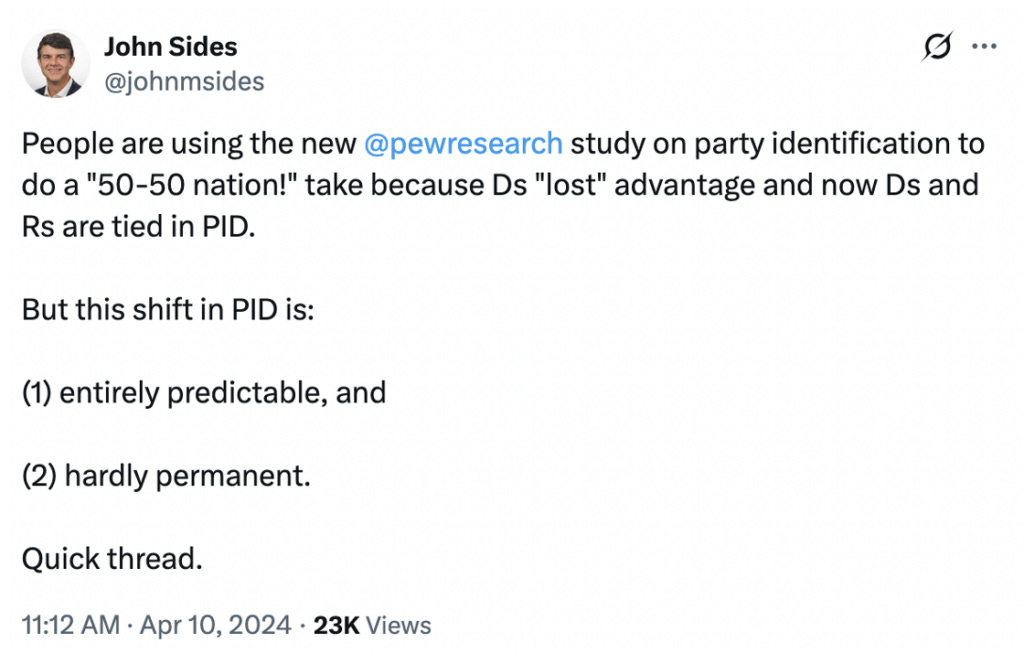
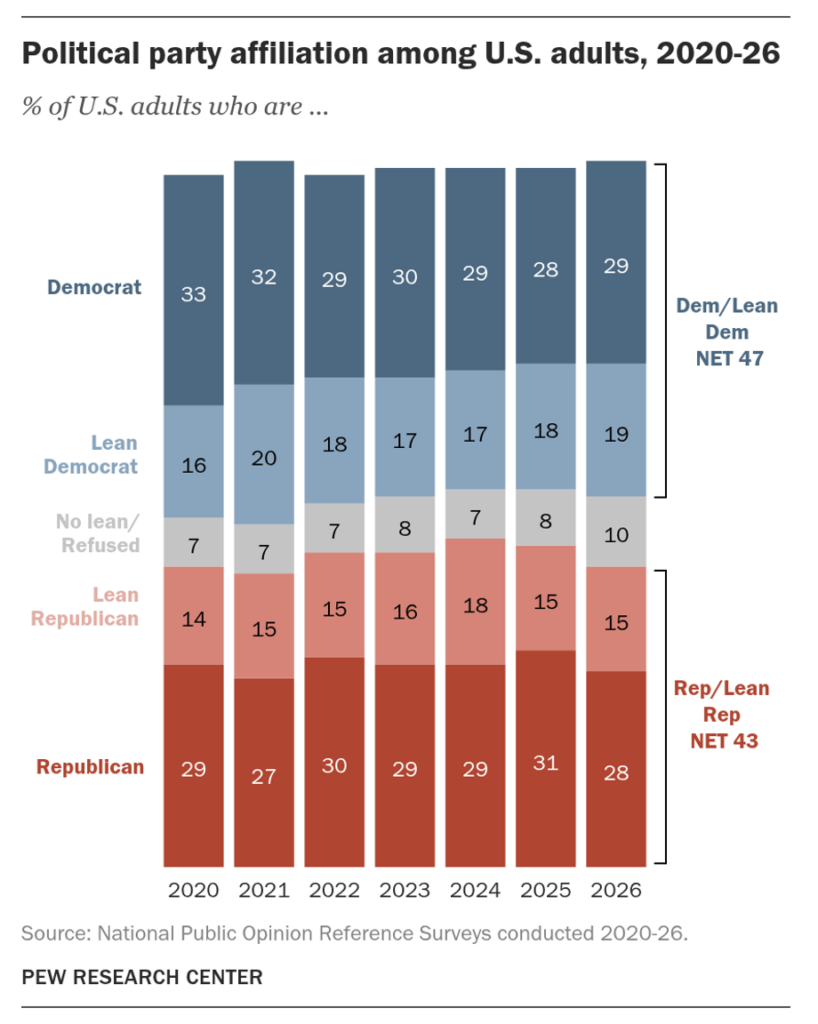
The context for that tweet was a 2024 Pew Research Center survey showing that the percentage of Americans who identified as Republican had increased and was equivalent to the percentage who identified as Democrats. That spawned the usual hot takes that I referred to in the tweet.
Pew has now updated its analysis to include a new 2026 survey and, indeed, the 2024 numbers were “hardly permanent.”
This is what Gallup’s polling shows as well:
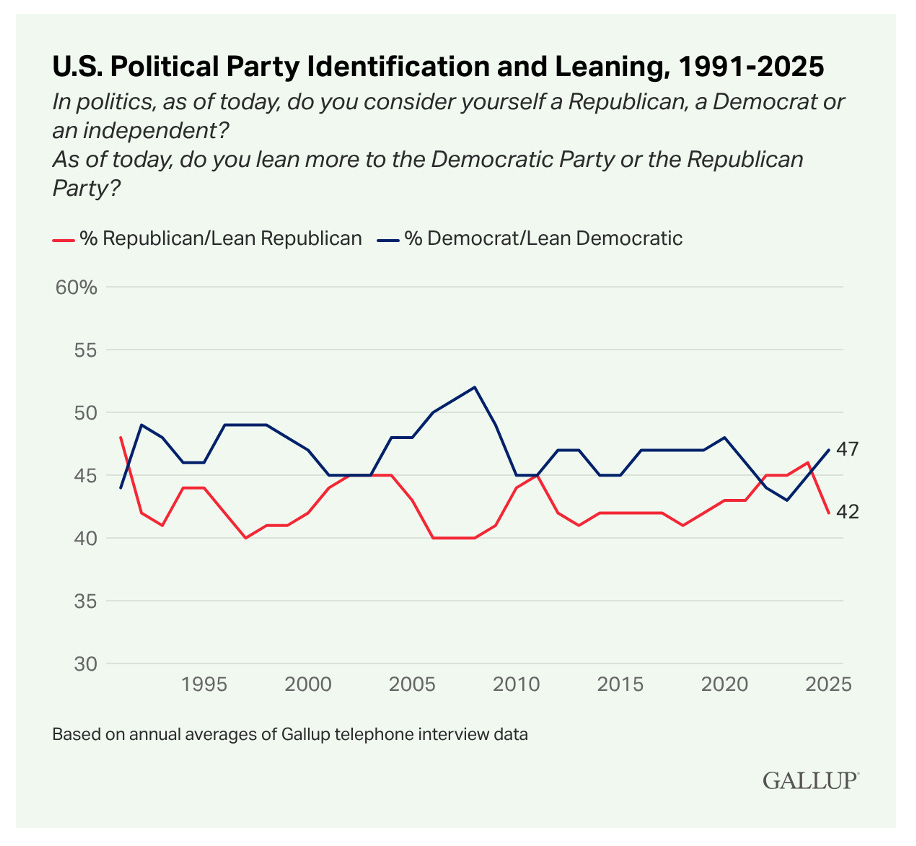
The story is simple. Although party identification is a fairly stable attribute of individuals, in the aggregate, it moves.
Specifically, it moves in response to presidential approval. If the president is unpopular, then party identification shifts toward the opposite party. That’s what happened to the Democrats under an unpopular Joe Biden.
Now it’s happening to the Republicans under an even more unpopular Donald Trump. I guess I quasi-predicted this in April 2024, saying that “if a GOP president is unpopular, PID will shift back in Democrats’ favor.”
Under the hood, of course, there can be longer and more permanent changes to the balance of Democrats and Republicans. Decades ago, there were far more Democrats in the electorate than Republicans. Over time, the distribution of partisans has moved much closer to parity.
But when we look at these year-to-year fluctuations in the overall distribution of Democrats and Republicans, we should not see them as harbingers. More often, they are just temporary reactions to the political environment.
Stay up to date on all things politics and political science. Bookmark our landing pageand sign up for Good Authority’s weekly newsletter.
 | A guest post by
|