
Why Washington keeps misreading Iran
What history and political science can tell us about the resilience of the Islamic Republic’s government and institutions.

ROYA IZADI
The U.S.-Israel war with Iran is now entering its sixth month. Despite a widespread and sustained campaign to decapitate Iran’s political and military leadership, the Iranian government has not surrendered. And Iran’s armed forces have continued retaliatory drone and missile strikes targeting U.S. forces as well as U.S. regional allies.
Early into this war, officials in Washington and Jerusalem expected to see the Iranian government collapse, particularly after U.S. and Israeli strikes killed two key Iranian figures. The apparent calculation was that the Iranian government had little base of support inside the country, and anti-government protests would finish the job and bring down the nearly 50-year Islamic Republic of Iran.
Political science research suggests that U.S. and Israeli officials made two fundamental mistakes. They’ve mistaken the pro-war Iranian diaspora in the streets of Toronto, Los Angeles, or Munich for Iran itself. And they saw postrevolutionary Iran as a regime similar to Saddam Hussein’s Iraq or Muammar Qaddafi’s Libya, where removing the leader decapitated the regime itself. And now, after many months, the same flawed assumptions continue to shape policy debates.
Iran is a post-revolutionary competitive authoritarian regime
How do we make sense of Iran today? The Islamic Republic was born out of one of the most consequential popular revolutions of the 20th century. Unlike many authoritarian governments in the region and beyond that were the result of military coups, the Islamic Republic emerged from a mass revolutionary movement that mobilized millions of Iranians from diverse social backgrounds.
Revolutionary governments differ fundamentally from regimes established through reshuffling coups. They inherit organizations, networks, and ideological commitments forged during the revolutionary struggle. These governments thus have a level of social penetration and institutional cohesion – other examples include China, Cuba, and Vietnam. And revolutionary regimes are often one of the most durable types of regimes, despite poor economic performance and hostile pressure from external forces.
In this light, it’s misleading to analyze Iran along the same lines as authoritarian regimes that emerged through military coups. Those regimes tend to be extremely fragile, as they were built around military seizures of power and depend heavily on a narrow ruling coalition. Iran’s post-1979 political order, in contrast, was constructed through a revolutionary process that fundamentally transformed government institutions and the new leadership’s relationship with society. Understanding that distinction is important for understanding why strategies that proved effective against authoritarian regimes in Libya or Iraq are unlikely to produce the same outcome in Iran.
Why Iran can quickly mobilize government supporters
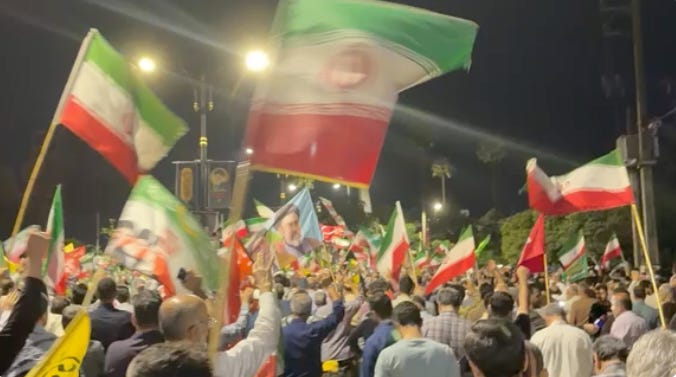
One of the Islamic Republic’s strengths is its organizational capacity. Over four decades, the government has built an extensive infrastructure capable of mobilizing supporters throughout the country. The Islamic Republic does not rule purely by coercion; it draws on networks embedded in places of worship, universities, and the government bureaucracy to organize demonstrations, commemorations, and other public events. These organizations give the government the ability to rapidly mobilize large numbers of supporters whenever it perceives political or external threats, including anti-government protests. For example, following major episodes of anti-government protests in 1999, 2009, 2018, 2019, 2022, and most recently in January 2026, large pro-government rallies took place across the country. These rallies are visible signs of public support for the government in times of crisis.
Analysts and policymakers outside Iran tend to overlook this organizational capacity. And anti-government voices among the Iranian diaspora community often dominate the wider public discussion of Iranian politics. This leads observers to conclude that people in Iran are uniformly opposed to the Islamic Republic. Of course, this does not mean that the Islamic Republic enjoys majority support – but nor does it mean it lacks significant opposition.
Survey research, for example, suggests that the Iranian government has a substantial social base. In a nationally representative survey I conducted in Iran in 2024, only 30% of respondents supported regime change (57% preferred gradual reforms and 13% preferred the status quo). More recently, political scientist Daniel Tavana and colleagues ran a nationally representative survey using an embedded list experiment – a method designed to reduce the incentives for respondents to conceal politically sensitive opinions. They found that 57% of respondents expressed support for the Islamic Republic when asked directly, but estimated support fell to 47% under the anonymity provided by the list experiment. In other words, even after accounting for preference falsification, nearly half of respondents still expressed support for the government.
What elections and protests tell us
Electoral results also indicate that the Islamic Republic retains a substantial constituency. In the 2021 presidential election, for example, approximately 23.9 million Iranians – 48% of voters – cast ballots for the three principal candidates, and over 22 million chose non-reformist candidates. To be sure, the most prominent reformist candidates were disqualified, and voting in an election does not necessarily imply support for the government.
How deep does this support run? In recent years, economic setbacks and the backlash against strict dress codes for women have culminated in a series of protestsagainst the Iranian government. But protests do not necessarily translate into support for regime change, and this is no guarantee that Iranians will rise up during a foreign military intervention and finish the job themselves. Extensive research in political science suggests that foreign threats produce a “rally around the flag” response, even in authoritarian regimes. U.S. sanctions against Iran produced this very effect, in fact. These political dynamics help explain why predictions of imminent regime collapse have failed to materialize.
The Islamic Republic has a particularly strong institutional structure
One of the biggest mistakes outside observers make is treating Iran as a purely personalist regime, under the control of the Supreme Leader. While the Supreme Leader is the country’s highest political and religious authority and commander-in-chief of the armed forces, the Islamic Republic is governed through a complex network of formal and informal institutions. Decisionmaking is also shaped by elected bodies, oversight institutions, competing political factions, the security establishment, the clerical elite, and an extensive bureaucracy. Throughout the history of the Islamic Republic, Supreme Leaders have repeatedly had to accommodate competing factions and political realities.
Presidential elections are neither fully free nor fully fair – the Guardian Council vets candidates before they can run. Yet Iran’s elections are competitive and meaningful. Parliamentary elections, in particular, let constituents reward or punish representatives for their performance in delivering resources, public goods, and local development.
Political scientists refer to Iran as a “competitive authoritarian regime” with multiple centers of power. This institutional complexity has important implications for regime resilience. Leadership decapitation is unlikely to produce regime collapse because authority is embedded in a broader institutional structure. These institutions are designed to reproduce leadership and maintain continuity. This helps explain Iran’s resilience after U.S. and Israeli attacks killed Supreme Leader Ayatollah Ali Khamenei in late February.
The role of Shi’a Islam in Iran’s military strategy
Iran is a majority Shi’a country, and this has important consequences for politics. In Shi’a thought, people historically see legitimate authority as a moral and organic relationship between the leader and the community, grounded in guidance and protection. At the heart of the Islamic Republic’s doctrine of rulership under velayat-e faqih (the Supreme Leader) is the concept of velayat, which means closeness, protection, and friendship.
In this light, understanding the relationship between Iran’s armed forces and political authority requires looking beyond the conventional Western understanding of civil-military relations and a military governed primarily by formal command structures and professional obligations. In Iran, the relationship between political leaders, military commanders, and soldiers also rests on religious loyalty and a spiritual sense of duty and sacrifice that goes beyond rank and hierarchy. The culture of martyrdom, for example, is rooted in the Shi’a memory of the 7th century battle of Karbala, and represents sacrifice in defense of a just cause as a source of moral authority.
In the 1980s, the Iran-Iraq War transformed this religious narrative into a lived experience for a generation of commanders who later entered Iran’s military and political institutions. The war created a collective memory that embedded sacrifice, endurance, and resistance within the country’s military decisionmaking structure. This spirit of resistance, in part, helps explain the apparent pain tolerance of the Iranian armed forces.
A key takeaway, then, is that Iran has resilient institutions, networks, and military forces that have a stronger capacity to absorb extraordinary losses that many assume. And it’s also important to remember that these losses are likely to bring ordinary Iranians closer to their government.
Roya Izadi is an assistant professor of political science at the University of Rhode Island and a 2026-2027 Good Authority fellow.
Stay up to date on all things politics and political science. Bookmark our landing pageand sign up for Good Authority’s weekly newsletter.
Brilliant insights. Thanks for sharing this. It continues to amaze me how willfully ignorant a government can be when choosing to attack another government.